
I used to think the most awkward part of dating apps was the small talk. Not the “hey”s, not the painfully original “how’s your week,” but the moment when you realize you’re negotiating reality with a stranger. Are they who they say they are? Are they single? Are they even real?
Lately, that question has started to feel less philosophical and more logistical. Like: do I need a new rule for screenshots?
The screenshot used to be a trump card
For years, screenshots were the currency of credibility. Your friend says, “He ghosted me,” and you say, “Show me.” Someone claims a wild opener, and there it is, cropped and highlighted like evidence. We used screenshots to vent, to warn, to laugh, and sometimes to build a case in the court of group chat.
But the “proof” has gotten suspiciously easy to manufacture. I found a tool that lets anyone whip up convincing conversations for practically every platform you can name, including Tinder and Bumble. It’s so clean and customizable it feels like a design template more than a prank. You can generate a fake bumble chat in minutes, and that’s the point: it’s frictionless.
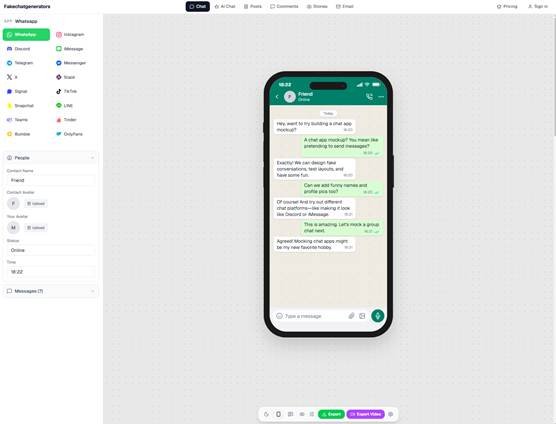
fakechatgenerators.com lets you mock up chat screenshots across 16 platforms
And look, I’m not naïve about why people do it. Some uses are harmless. Comedians and creators need props. Students need examples. Film crews need mockups. UX designers need something that looks like real life without involving real people. Plenty of these screenshots will never leave a storyboard.
Still, the same convenience that makes a meme possible also makes a lie portable.
When “receipts” stop meaning receipts
The uncomfortable part is not that fakes exist. It’s how quickly they slot into our habits. We already share dating app screenshots casually, often without consent. We blur names (sometimes). We don’t blur faces (often). We narrate the other person into a villain or an idiot because it makes the story better and the night more entertaining.
Now add plausible fabrication to that. Suddenly, anyone can “prove” their version of events with a cleanly typeset exchange and just enough specificity to feel real. A friend’s ex can be recast as cruel with a few invented lines. A creator can stage a brand’s “unhinged” DM to juice engagement. A person can preemptively discredit someone else by posting an imaginary conversation first.
The real damage isn’t limited to embarrassment. Dating app screenshots can be used as social leverage, workplace ammo, even legal pressure. When the baseline trust in the artifact collapses, the fallout doesn’t distribute evenly. People with less social power, fewer resources, and more to lose get hit hardest.
And we adapt in predictable, messy ways. We start demanding more proof. We ask for screen recordings. We ask for timestamps. We ask for the thing behind the thing. The burden of credibility shifts to whoever is already vulnerable, especially women reporting harassment. “Receipts” become a tax.
Bots aren’t new, but they’re getting better at acting human
There’s another layer here. Even if a screenshot is genuine, the conversation might not be. The person on the other end might be outsourcing replies, using scripts, or running some halfway automated routine that keeps matches warm like bread in an oven.
A dating app chat is already a performance. We choose our best photos. We polish our answers. We rehearse lines. The difference now is that automation can do the performing for you, and it can do it at scale. The signals we used to rely on, a typo, an odd pause, a slightly too earnest paragraph, don’t reliably separate person from program anymore.
That uncertainty creeps into your nervous system. You find yourself scanning messages for tells. You wonder if your joke landed or if it triggered a response pattern. You start treating the conversation like a captcha you didn’t sign up for.
It’s exhausting. And it changes your boundaries in subtle ways. You disclose less. You assume less good faith. You keep one foot out the door, because you don’t know what you’re standing on.
The arms race: fabrication on one side, detection on the other
Whenever fabrication becomes easy, detection becomes a business. That’s the logic of the internet: every new tool spawns its shadow tool, and then a tool to police the shadow.
I’ve been watching the rise of “is this real?” services with mixed feelings. On one hand, I understand why journalists, banks, marketplaces, and trust and safety teams need them. On the other, the idea that everyday people might soon run a dating profile photo through an authenticity check like they’re inspecting a used car report is… bleak.
Still, the technology is here. Tools like an ai image detector promise 98.7% detection accuracy across 50-plus generative models, with sub-150ms latency, and they don’t just flag AI imagery. They look for NSFW content, violence, and document tampering too. That tells you something about where this is headed: not just “is it fake,” but “is it safe,” “is it altered,” “is it a trap.”
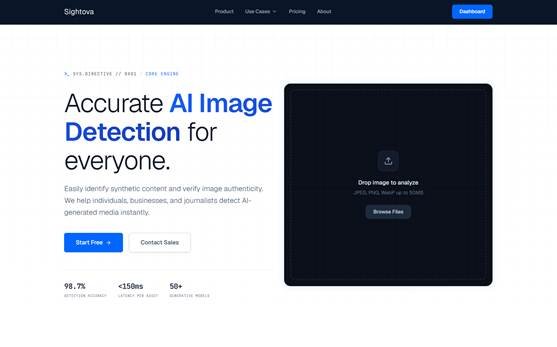
sightova.com flags AI-generated, tampered, NSFW, and violent imagery in milliseconds
The irony is hard to miss. We built social platforms around frictionless sharing, and now we’re building verification layers to survive the consequences of frictionless sharing.
Boundaries that don’t rely on forensic work
Here’s the part I keep coming back to: I don’t want dating to become a technical discipline. I don’t want to treat every new match as a potential fraud investigation. I also don’t want to be the person who shrugs at deception because “that’s just the internet.”
So what’s left? Boring, human boundaries. The ones that hold up even when evidence gets slippery.
A few that feel reasonable to me:
- Treat screenshots as stories, not verdicts. They can be a clue. They’re not a court transcript. If someone is asking you to join a pile-on, pause.
- Normalize consent around sharing chats. Even when someone “deserves it,” blasting private messages is still a choice you make about your own values.
- Move slowly when stakes are high. If someone is pushing intimacy fast, trying to isolate you, or steering you toward money, off-app platforms, or secrecy, that’s a bigger signal than whether their grammar is flawless.
- Ask for reality, not proof. A quick voice note, a short video call, a meet in a public place, a consistent story over time. None of this guarantees safety, but it’s grounded in interaction, not artifacts.
- Keep your dignity separate from their behavior. If you got fooled, you’re not stupid. You’re human. The point of these systems is to exploit normal trust.
These aren’t foolproof. Nothing is. But they don’t require you to become a part-time analyst.
Believability is the new battleground
What scares me isn’t that bots can talk, or that fake screenshots can circulate. It’s the cultural shift that follows: when everything is plausible, the loudest narrative wins. The most shareable “receipt” wins. The slickest fabrication wins. And the person who is cautious, nuanced, or private starts to lose by default.
Dating apps already ask us to make snap judgments based on thin slices of information. Now those slices can be engineered from scratch, and that means the rest of us have to decide what we’re willing to accept as “real enough.”
Maybe that’s the true boundary conversation, not just what we share, but what we believe. If the next era of online dating is an arms race between believable bots and better detection, I’d rather plant my flag somewhere quieter: in consent, in patience, in not performing certainty when I don’t have it.
Because the truth is, I miss when the hardest part was just saying something interesting after “hey.”